In this post, you will learn how to run an interactive job on ARCHER2 for postprocessing using Paraview.

In this post, you will learn how to run an interactive job on ARCHER2 for postprocessing using Paraview.
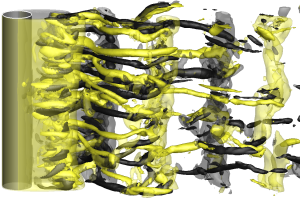
by Hongyi Jiang (University of Western Australia)
DOI: 10.1063/5.0041168
Using Nektar++, we report a systematic numerical convergence study for the case of flow past a circular cylinder at Re = 3900.

The 5th annual Nektar++ Workshop will bring together developers and users of all experiences to hear about new and future developments in Nektar++ and the exciting science and engineering being undertaken with the code.

At our recent Nektar++ tutorial we produced a number of videos supporting the background of the framework. We include them here for general reference and also make the presentations available in Keynote and Powerpoint formats.
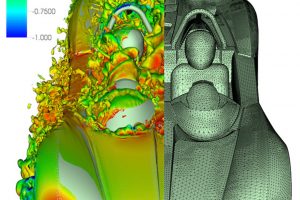
We present the successful deployment of high-fidelity Large-Eddy Simulation (LES) technologies based on spectral/hp element methods (SEM) to an industry-relevant configuration. The simulation is carried out on a real automotive car, namely the Elemental Rp1 model.
The ARCHER2 national supercomputer is a world class advanced computing resource and is the successor to ARCHER. This guide is intended to provide basic instructions for compiling the Nektar++ stable release or master branch on the ARCHER2 system.
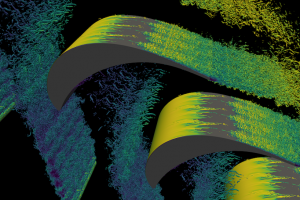
This blog highlights some research efforts aimed at simulating the wake passing effect in a low pressure turbine cascade, analysed over the entire operating range. The incoming disturbances modify the physical transition mechanism on the suction surface, giving rise to complex flow phenomena.
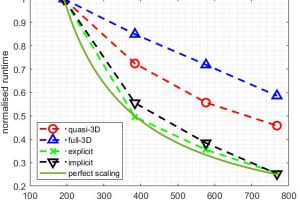
There are various flow solvers built in Nektar++ that exploit different numerical approaches. This this article provides some results on the comparison of four different solver setups that are commonly used, based on two standard benchmark cases.
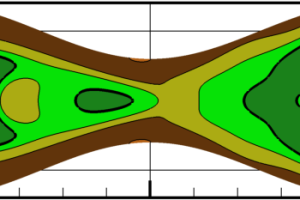
Can hydrodynamic instability be used for mixing? And at the same time can conduits be shaped such that hydraulic losses are reduced? We think that it is Yes to both.

This post details how to undertake an MPI build of Nektar++ on Windows 10. Support has recently been added for building with MPI on Windows and a detailed explanation is provided of how to carry out the build and test process and run a sample simulation.